BND Inc. Insights / Specimen Collection
Choosing the Right Medical Swab: A Practical Guide for Canadian Healthcare and Laboratory Teams
Understanding cotton, rayon, flocked and foam swabs—and why the specimen, test method and transport system should guide selection
Medical swabs may look like simple supplies, but choosing one for clinical or laboratory use is rarely as simple as selecting a tip and placing an order.
The specimen being collected, the anatomical site, whether the sample will undergo culture or molecular testing, the transport medium, sterility requirements and the receiving laboratory’s instructions can all affect which collection device is appropriate.
At BND Inc., we see swab selection as part of the complete specimen collection process. The swab has to work with what comes before and after it—from collection technique through transport and laboratory testing.
That means the first question should not necessarily be, “Which swab material is best?”
A better question is:
| What specimen are we collecting, and what does the laboratory or test manufacturer require us to use? |
Start with the Test, Not Just the Swab
Different tests can require different specimen types and collection systems.
For example, Public Health Ontario currently specifies particular collection kits and transport media for respiratory virus molecular testing. Nasopharyngeal and throat specimens are collected using the appropriate swab and submitted in universal transport medium, with collection and handling requirements defined by the laboratory.
This is an important principle beyond respiratory testing.
A swab may be physically capable of collecting a specimen without necessarily being validated for the assay, culture method or transport system that follows.
Before selecting a swab, confirm the:
specimen type and anatomical collection site
test or culture being performed
swab material and shaft requirements
required transport medium
breakpoint or tube configuration, where applicable
sterility requirement
receiving laboratory or test manufacturer's instructions for use.
The laboratory protocol or assay instructions should take priority whenever a specific swab or collection device is required.
Understanding Common Medical Swab Types
BND Inc. supplies several different swab and applicator formats for healthcare and laboratory processes. Each serves a somewhat different purpose.
Cotton-Tipped Applicators: Familiar and Versatile
Cotton-tipped applicators are among the most recognizable swabs in healthcare.
BND's non-sterile cotton-tip applicator (DIS-003) uses a highly absorbent USP-grade cotton tip on a 6-inch wooden shaft. The product is intended for applications including routine microbial sampling and wound-related use where the applicable procedure permits a non-sterile applicator. BND also carries a sterile cotton-tip applicator for procedures where sterile presentation is required.
Cotton applicators can be useful when absorbency and controlled application are more important than specialized specimen recovery or compatibility with a particular diagnostic platform.
However, a cotton swab should not automatically be substituted for the swab supplied or specified with a diagnostic test. For laboratory specimen collection, always confirm compatibility with the test method and receiving laboratory.
Rayon Culture Swabs: Collection and Transport in One System
When the objective is bacteriological culture, the swab and the transport medium need to be considered together.
BND's Sterile & Clear Culture Swab (DIS-110) uses a rayon tip and Modified Amies gel without charcoal. The system is designed for collection and transport of bacteriological specimens, with the transport tube helping protect the medium during transit. BND notes that the clear Modified Amies formulation supports survival of a broad range of bacteria and is compatible with Gram staining.
BND also supplies Single Modified Charcoal Swabs (LAB-102). These use a rayon swab with Modified Amies charcoal gel. According to the product information, the charcoal helps neutralize substances that could affect recovery of more fastidious organisms during transport.
Canadian laboratory practice also demonstrates why this distinction matters. Culture collection instructions may specify Amies transport systems with clear or charcoal media depending on specimen type and the organism being investigated.
So rather than treating “culture swab” as a single product category, consider the specimen source, suspected organism and laboratory protocol before choosing between transport systems.
Flocked Swabs: Designed for Specimen Collection
Flocked swabs use short fibres arranged around the swab tip rather than a traditional tightly wound absorbent tip.
BND's STC-200 Flocked Swab uses a nylon flocked head with an ABS shaft and is available in a nasopharyngeal configuration. The BND catalogue lists breakpoint options intended to support placement of the collected swab into the associated transport system.
Flocked swabs are commonly incorporated into respiratory and molecular diagnostic collection procedures, but the collection site still matters. A nasopharyngeal swab should not automatically be treated as interchangeable with a nasal or oropharyngeal swab simply because all three are flocked.
Public Health Ontario, for example, provides different collection instructions based on the respiratory specimen being obtained and advises using the swab intended for the specific anatomical collection method.
Foam Swabs: Another Respiratory Collection Option
Foam swabs provide a different tip construction and can be used in specific diagnostic collection processes.
BND's STC-205 Foam Swab uses a medical-grade polyurethane foam head with an ABS shaft and is available with different breakpoint distances.
That last point is an important reminder about swab purchasing in general: compatibility with a defined test is more useful information than material alone.
A foam swab that has been specified or authorized for one testing platform should not automatically be assumed suitable for every respiratory assay.
Rayon culture swab · LAB-102 | 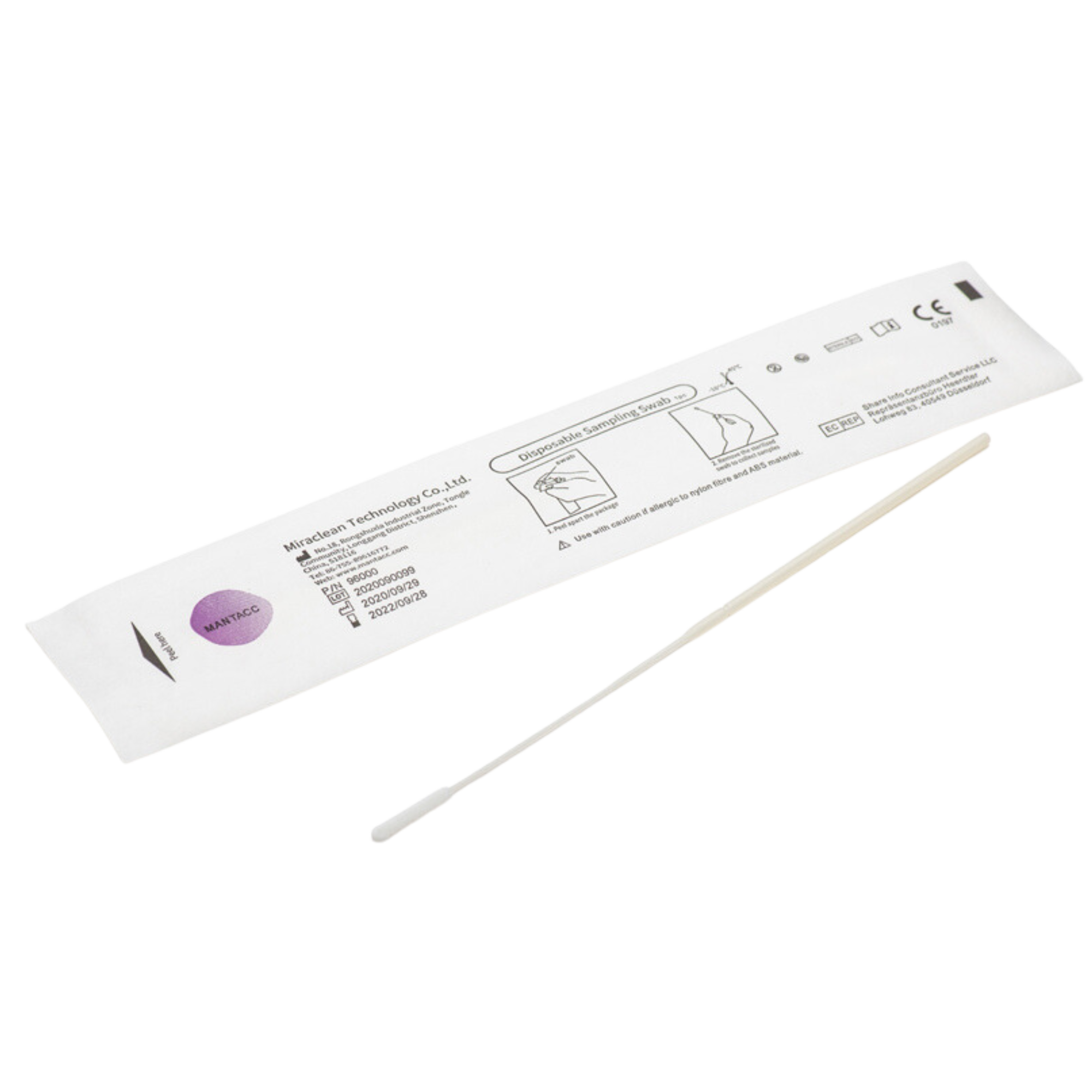 Flocked swab · STC-200 |
Sterile vs. Non-Sterile: Follow the Intended Use
Sterility is another important purchasing consideration, but it should be assessed within the context of the procedure.
BND carries both sterile and non-sterile applicator formats. The appropriate choice depends on the intended use, infection-prevention requirements, specimen collection procedure and laboratory or manufacturer instructions.
For diagnostic specimen collection, collection kits frequently provide a sterile swab to help protect specimen integrity before use. BND's respiratory transport products, for example, incorporate sterile specimen-collection swabs into the collection system.
Non-sterile applicators may have a role in other general laboratory or clinical applications when the applicable procedure allows them.
The important purchasing question is therefore not simply:
“Is sterile better?”
It is:
“Does this procedure or test require a sterile device?”
Don't Forget the Transport Medium
Choosing the correct swab is only part of specimen collection.
Once the specimen has been collected, the system needs to maintain it appropriately until testing. For this reason, swabs and transport media should often be evaluated as a single process rather than two independent products.
Viral Transport Systems
BND's STC-100 Viral Transport Medium Kit combines a sterile nylon-tipped flocked nasopharyngeal swab with a self-standing tube containing Hanks Balanced Salt Solution-based viral transport medium. The swab incorporates a breakpoint so the collected portion can be placed into the transport tube and securely capped.
BND also carries viral sampling kit configurations for nasal and oral collection.
Current Public Health Ontario respiratory-virus instructions similarly emphasize the relationship between the specimen, swab, transport medium, temperature and time to laboratory receipt. For many respiratory specimens collected by healthcare professionals, PHO specifies storage at 2–8°C after collection and transport according to its laboratory requirements.
The exact conditions depend on the testing system, however, so local procedures and current laboratory instructions should always be checked rather than applying one transport rule to every swab specimen.
Bacterial Culture Transport
For bacteriological specimens, Modified Amies transport systems help maintain specimens between collection and culture.
BND offers both clear Modified Amies and charcoal-containing Modified Amies configurations. The appropriate choice depends on what is being collected and what the receiving laboratory specifies.
Again, the practical lesson is simple:
The collection device does not end at the swab tip.
The tube, medium, closure, storage conditions, labelling and transport process all contribute to the integrity of the specimen reaching the laboratory.
A Practical BND Swab Selection Guide
Compare the collection need with the swab and transport system specified by your receiving laboratory or test manufacturer.
| Collection need | BND product | Selection guidance |
|---|---|---|
| 01General application or permitted routine sampling | Non-sterile Cotton Tip Applicator — DIS-003 View product details → | When to consider: When an absorbent cotton applicator is suitable and the procedure does not require sterile presentation Key point: USP-grade cotton tip; 6-inch wooden shaft |
| 02General application requiring sterile presentation | Sterile Applicator — Cotton Tip View product details → | When to consider: When the procedure specifically requires a sterile cotton applicator Key point: Confirm suitability for the intended procedure |
| 03Bacteriological specimen collection and transport | Sterile & Clear Culture Swab — DIS-110 View product details → | When to consider: When the laboratory specifies a rayon swab with clear Modified Amies transport medium Key point: Sterile rayon swab; clear Modified Amies gel |
| 04Bacteriological specimens where charcoal medium is specified | Single Modified Charcoal Swab — LAB-102 View product details → | When to consider: When the receiving laboratory requires or permits charcoal Modified Amies Key point: Rayon tip; charcoal Modified Amies gel |
| 05Nasopharyngeal specimen collection | Flocked Swab — STC-200 View product details → | When to consider: When a compatible diagnostic or laboratory protocol specifies an NP flocked swab Key point: Nylon flocked tip; ABS shaft |
| 06Selected respiratory rapid-test processes | Foam Swab — STC-205 View product details → | When to consider: When the diagnostic platform specifies or permits the foam configuration Key point: Medical-grade polyurethane foam tip |
| 07Viral specimen collection and transport | Viral Transport Medium Kit — STC-100 View product details → | When to consider: When a complete flocked-swab and viral-transport-medium collection system is required Key point: Sterile NP swab plus transport-medium tube |
| 08Nasal or oral viral specimen collection | Virus Sampling Kits — STC-110 / STC-111 / STC-120 View product details → | When to consider: When the collection protocol specifies the corresponding nasal or oral configuration Key point: Swab, breakpoint and transport system supplied as a kit |
Common Swab-Selection Mistakes
One of the easiest mistakes is choosing a swab based primarily on how the tip looks. Two products may appear similar while being designed for different anatomical sites, transport systems or diagnostic methods.
Another is treating the swab separately from the laboratory procedure. A good specimen still needs the correct medium, proper labelling, secure packaging and timely transport.
Substituting one collection site for another can also be problematic. Nasal, nasopharyngeal and oropharyngeal collections are not identical procedures, and the associated swab designs may differ. Public Health Ontario provides distinct instructions for these collection methods.
Finally, don't assume that because a swab is marketed for specimen collection, it is automatically compatible with every test. Point-of-care and molecular assays may include very specific collection-device requirements.
Five Questions to Ask Before Ordering Swabs
| No. | Before ordering, confirm |
|---|---|
| 01 | What specimen or task is the swab being used for? Define the anatomical site and whether the purpose is culture, molecular testing, rapid testing, application or another clinical/laboratory procedure. |
| 02 | What does the test manufacturer or receiving laboratory specify? Check the assay instructions, laboratory collection manual or current institutional protocol before making substitutions. |
| 03 | Is sterile presentation required? Match the sterility status to the procedure rather than assuming one format fits every use. |
| 04 | Does the specimen require transport medium? If it does, determine which medium, tube and storage conditions are required and whether a complete collection kit would simplify the processes. |
| 05 | Will the product work operationally? Consider shaft length, flexibility, breakpoint position, packaging, labelling, transport security, storage and standardized use across sites. |
These questions can help prevent a purchasing decision from becoming a specimen-quality problem later in the process.
How BND Inc. Supports Specimen Collection Procedures
At BND Inc., we work with Canadian healthcare and laboratory teams across more than one part of the collection process.
Our specimen collection range includes cotton applicators, rayon culture swab systems, flocked and foam respiratory swabs, viral transport systems, specimen containers, biohazard bags and other laboratory supplies used from collection through transport. BND's current specimen collection category includes dedicated swab, culture and viral-transport options alongside other collection products.
For organizations standardizing supplies across clinics, laboratories or multiple sites, the goal should not simply be to stock more types of swabs.
The goal is to stock the right collection systems for the procedures being performed—with clear product selection, consistent staff training and processes and alignment with laboratory and test-manufacturer requirements.
Because when specimen quality matters, a swab is not just a swab.
It is the first step in the testing process.
Important Clinical Note This guide is intended for general educational and product-selection purposes and should not replace laboratory collection instructions, institutional policies, manufacturer instructions for use, professional medical advice, or current public-health guidance. For specimen collection and transportation, always follow the requirements of the receiving laboratory and the instructions supplied with the applicable diagnostic test or collection device. |
For current respiratory collection and transport requirements, see Public Health Ontario’s respiratory viruses laboratory instructions.